


Environment STATEMENT
"There’s this old story about blind men describing an elephant. One touches the trunk and says it’s a snake; another touches the leg and says it’s a tree. Each one is describing a part of the elephant accurately—but only a part. That’s what complex work is like. By speaking up, we piece the truth together. Without your perspective, the picture stays incomplete."

Set the Stage
Setting the stage means explaining why speaking up matters to the team’s success. Do this in interviews, onboarding, 1-on-1s, and team meetings. Here are three types of statements to get you started:

MISSION
STATEMENT
"Our mission doesn’t belong to one person—it belongs to all of us. That means progress depends on everyone’s input. If something isn’t working, if you see a better way, we need to hear it. That’s not extra. That’s the job."

LOSS
STATEMENT
"By speaking up, we prevent the kinds of mistakes that affect the people we serve. One missed insight or silent hesitation can cost our clients trust, time, or results. If we want to deliver at our best, we can’t afford silence."

Use your EARS
Show us a psychologically unsafe leader and we’ll show you a bad listener. Use NextArrow’s EARS method to get into a listening mindset:
- Encourage
- Amplify
- Reflect
- Spark


Fail intelligently
The hallmark of psychological safety is a culture that learns from mistakes. In that culture, people feel safe to:
- Ask for help
- Report errors
- Learn from failures
- Experiment thoughtfully


Enable Feedback
Ask for feedback.
Share developmental goals.
Evaluate yourself with two scores:
- The 1st score: External evaluation
- The 2nd score: Internal evaluation


Invite your team to complete a Failure CV:
What are 1–2 things you failed at in the last year that you’re willing to share with your team?
Write: failure + lesson + next steps.
Gage
Below is a survey you can use to gauge your team’s level of Psychological Safety. Score how strongly you agree with each statement using a 1-5 scale (1 being low and 5 being high).
- If I make a mistake on this team, it’s held against me.
- Members of this team can bring up problems and tough issues.
- People on this team sometimes reject others for being different.
- It’s safe to take a risk on this team.
- It’s difficult to ask other members of this team for help.
- No one on this team would deliberately act in a way that undermines my efforts.
- Working with members of this team, my unique skills and talents are valued and utilized.
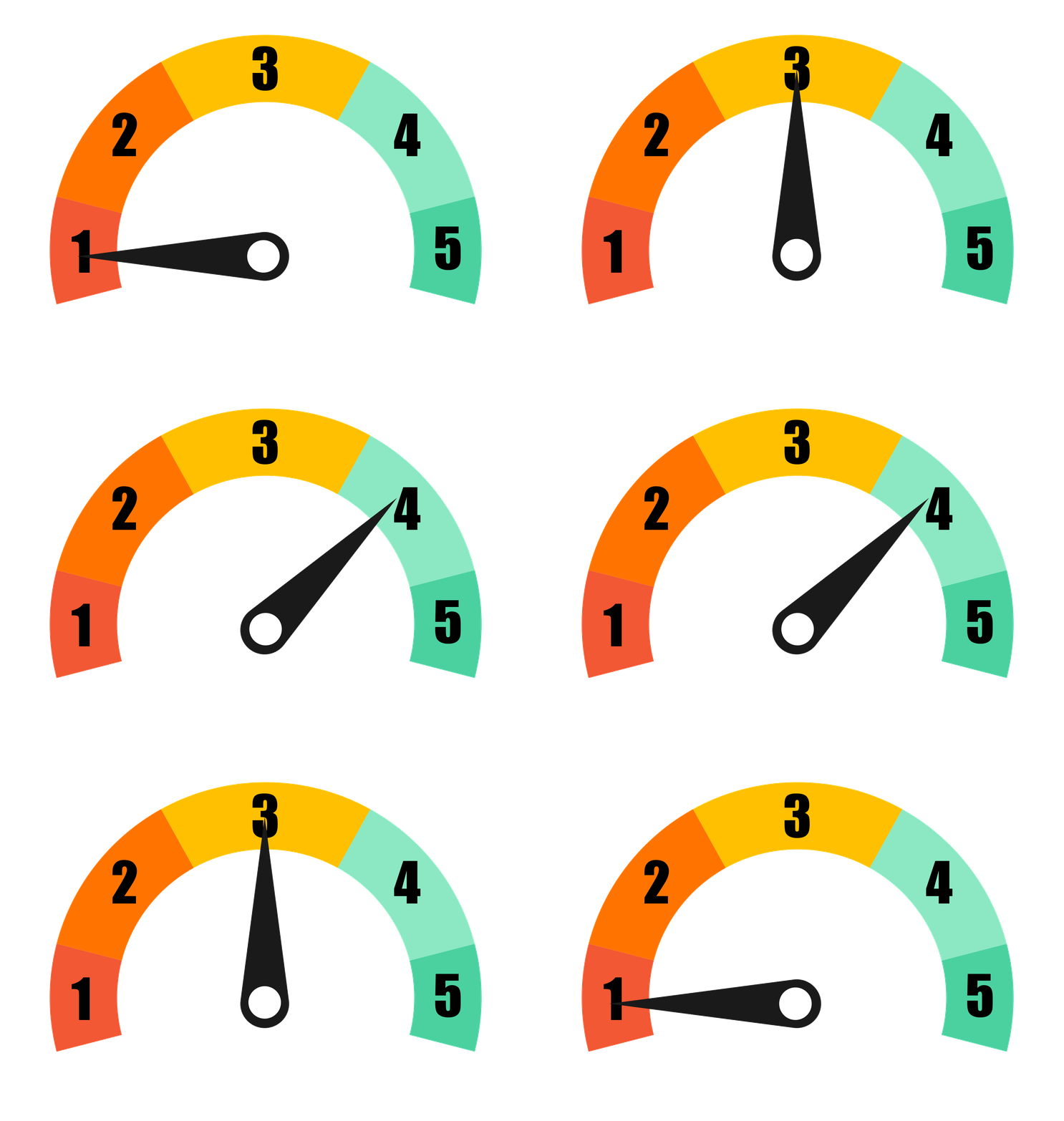
Once you survey your team, set a time to discuss the results. Potential steps include:


Discuss
Co-create change:
“Here are our two lowest scores. Let’s discuss what these mean to you and brainstorm ways to improve.”
Articulate commitments:
“Here’s what I want to commit to doing and here’s how I’d
like to be held accountable.”
Assign team members to a project:
“Who would like to spearhead our new 'Failure Sucks, but Instructs' initiative?”
Collect Feedback:
“It’s been a month since we tried X. I would love to get feedback from the team on what’s working well and what could be improved. What should we start doing? What should we stop doing? What should we continue doing?.

Deepen your learning


As always, we would love to hear from you. You can reach us at hello@nextarrow.org or connect with us on LinkedIn
